Showing posts with label old world lighting. Show all posts

Friday, June 19, 2020

Decorating With Venetian Gondola Lanterns


Antique lanterns are always a great accent accessory for the old world home. There are many beautiful styles to look for as you peruse antique shops, auctions, second hand and thrift stores, etc. I especially like the pole lanterns so this post will feature the Venetian gondola lantern with another to follow soon all about the religious processional lanterns.

Venice, while charming by day, I am told is extraordinarily beautiful at night. One of Europe's most romantic cities now has approximately 500 gondolas traveling the 150 canals that meander through it. A nocturnal gondola ride must be breathtaking. However, during the 17th-18th centuries it is said that these these canals were crossed by over 10,000 gondolas. Can you even imagine the spectacular sight of the darkness alive with these flickering antique gondola lanterns.

These lovely gondola lanterns are sought after and treasured antiques that are presently popular for decorating the homes of collectors as well as those just wanting an old world flavor added to their homes. If you are fortunate enough to have one already....treasure it. If you find one for sale somewhere and can afford it.....buy it. The instant old world feel they bring to a space is worth it. Happy treasure hunting!!!


Lanterns called fanali were used to light the gondolas. I have tried and tried but really can't find info on if the gondola lanterns started out on poles or were eventually transferred to them.

Giovanni Antonio Canal

Gondolas were a bit different from the simpler black ones we see in Venice today. They could be quite elaborate as seen in these two paintings by Giovanni Antonio Canal. I can see elaborate poled lantern torches used on gondolas like these because there would be plenty of room for them.

Giovanni Antonio Canal

I do know that among the Venetian nobility it became popular to compete with each other for the most beautiful and luxurious gondolas. Maybe they used plain lanterns on simple gondolas and the more ornate on expensive ones. Can't seem to find that out.

Palazzo Widmann

Like an expensive car, the gondola became a status symbol with elaborately carved and gilded ornamentation. For the interiors seasonal fabrics such as silk and velvet were used that added to the luxury. Maybe it became fashionable for the elite to put their lanterns on a pole....like a floor lamp or torch.

1stdibs.com

In fact gondola decorating in 1562 got so far out of hand that the authorities banned what was seen as sinfully ostentatious ornamentation and the Venetian Doge decreed that all gondolas were to be painted black. They are still black today.


 A gilt metal 19th century gondola lantern attached to gilt and painted wood pole. Of course this one has been electrified. She is showing how they would hold the lanterns.

via Pinterest

Exceptional pair of large 18th century wood and glass Baroque Venetian gondola lantern torches.


A pair of late 19th century Venetian bronze and red painted gondola lanterns. This shows just how beautiful these lanterns are when electrified and used in your old world interiors.

via Olimpia Orsini

source unknown


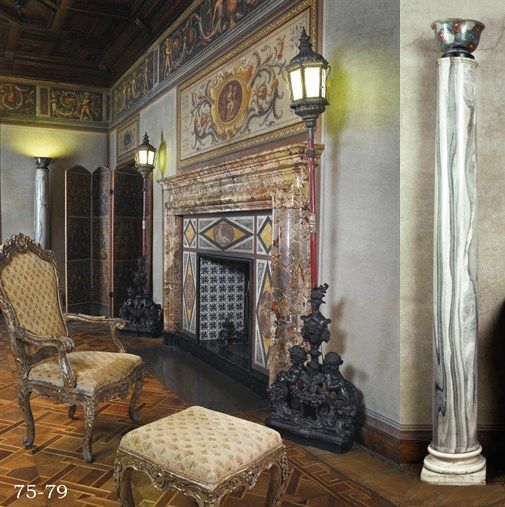
You can see a beautiful gondola lantern in the background of this interior in Villa Fontana, the home of collector Bill Eberhardt.


Throughout medieval Europe religious sculptures in wood and other media were often brightly painted or colored, as were the interiors of church buildings. This is called polychrome. Many Venetian gondola lanterns were polychromed.


A lovely pair of red polychromed Venetian gondola lantern torcheres. Polychrome from the Greek .... "poly-", meaning "many" and "chromos", meaning "color."


A 19th century Gondola lantern from Venice, Italy. Polychromed and stamped tin, wood and glass, it is 6 sided and decorated with leaves, scrolls, and flowers. The top is a wood finial. You can see how the lantern is meant to be inserted onto a decorative pole.


A painted hexagonal tole gondola lantern with putto supports and embellished allover with gilt. This one has a spiral twist pole that has been painted blue.


via Pinterest

Whether you just lean them in a corner or electrify and use them on a regular basis these gondola lanterns just reek with old world charm.


Beautiful gondola lantern with cherub head embellishments.


Another clever way to enhance your decor with antique Venetian gondola lanterns.

via Pinterest

architecturesinterior.co

There is a certain charming elegance to these gondola lantern torches.

 source unknown

And yet the gondola lantern's old world elegance is as much at home in a simple and shabby interior.


via Pinterest

I love a casual old world vignette involving one or more of these lovely gondola lanterns simply leaned against the wall.

etsy.com

I have Venetian gondola lantern envy over these beauties!!! I can think of so many places to put them.

Pamono.com

Most gondola lanterns were gilt or painted wood. However some were metal and here is where it gets tricky. Religious ceremonial lantern torches were also usually metal so it is easy to mix them up. This could be religious so don't be too harsh if I am incorrect.

More gondola lantern torches in the loggia of Bill Eberhardt's Villa Fontana.


It is hard enough to find single gondola lanterns, but in pairs......super fortunate!!


Click here to see the previous post


This blog post was published by Lisa Farmer


Monday, November 25, 2019

Create Old World Interiors With Murano Glass Chandeliers


There are some elements of design that are iconic symbols of refined taste and wealth. Murano glass chandeliers are one of those symbols and are recognizable all over the world. Since the 13th century the island of Murano has been the undisputed nerve center for Venetian glass production. With the creation of cristallo, a transparent glass that was considered the finest glass in the world, and a white colored glass (that we know as milk glass) called lattimo, Murano became Europe's first major glassmaking center, reaching the peak of its popularity in the 15th and 16th centuries. The first Murano glass chandeliers to be produced by Venetian glassmakers date back around the year 1700. You have to remember that these chandeliers replaced the heavy wooden and wrought iron chandeliers of the past. Can you imagine how these beautiful translucent chandeliers appeared airy and almost magical. Is it any wonder the Murano glass chandelier was desired for grand and opulent interiors? 

Today the descendants of these famous  glassmakers continue to create gorgeous chandeliers and other pieces of glass art that are coveted by modern-day customers. 


Around 1730 the Rezzonico family ordered a chandelier from Murano masters for the grand  residence they were building, Ca'Rezzonico, overlooking the Grand Canal in Venice.

Glass masters in the factory of Giuseppe Briati created what it's now called the Rezzonico Chandelier, a fabulous two-tier colorful work of art featuring twenty candle-holders. This chandelier is representative of the classic Murano chandelier. It is considered the most amazing such chandelier in existence today and still hangs in it's original room at Ca'Rezzonico.


Murano Glass chandeliers are still produced in Murano workshops and are in high demand for residences, hotels, theaters, restaurants, and other public spaces. Here they hang in Venice's Palazzo Widmann built in 1630. These chandeliers are decorated with gorgeous colors and are meant to represent a bouquet of flowers.


 The Murano glass industry flourished as the artists pushed themselves to create unique and elaborate chandeliers for the rich Venetian nobility. 


The beautiful Murano glass chandeliers were such a success they instantly brought chandeliers to a new dimension.


Elaborate yet delicate arabesques of beautifully colored leaves, flowers, and fruits are typical features of Murano glass chandeliers.


This was made possible by the unique type of glass used in Murano. It was called soda glass and was famous for it's extraordinary lightness which was different from all other glass at the time.


With their colors and fantastical artistry, Murano glass chandeliers add a bit of whimsy to the seriousness of otherwise grand interiors.

Designer, Jacques Garcia

Although Venetian glassmaking in factories existed as far back as the 8th Century, it did not originate on the island of Murano. Beginning in 1291 the Venetian Republic ordered the glassmakers to move their furnaces to the island because the glass factories caught fire frequently and posed a threat to the city.


Plus the Venetian glassmaker's secret formulas and methods of producing these fabulous chandeliers would be better protected and controlled on the island of Murano.

via Pinterest

An incredible amount of skill and time was required to precisely twist and shape a chandelier. Every shape of glass had to be masterly executed because any outsize piece wouldn't fit to be mounted between the others.

Design Firm Studio Peregalli


This old world formal dining room by Renzo Mongiardino features a stunning 17th-century Murano glass chandelier.


Another extremely beautiful and delicate Murano glass chandelier in Christian Dior’s Château de la Colle Noire.


A Murano glass chandelier graces the dining room at Dumfries House, considered the most beautifully intact house in Scotland.


A close view of the Dumfries House glass chandelier.

Equally beautiful are the clear Murano glass chandeliers. A series of these beautiful chandeliers beckon you down this fabulous corridor. In the 15th century master glassmaker Angelo Barovier discovered the processes of making “Cristallo Veneziano”, the world's first truly clear glass


Rosenborg Palace in Copenhagen

One of the first Murano chandeliers was made for Frederick IV of Denmark and still hangs in his former palace, Rosenborg.

via Pinterest

Decoration was always put before functionality when it came to Murano glass chandeliers. These status symbols were means of showing one's wealth firstly, illumination came in second.

via Pinterest

In other countries crystal was being used on chandeliers. Since Murano glass was extremely fragile it could not be faceted so the Venetian glassmakers relied on the delicate and unique quality of their glass.

I love the way the clear glass Murano chandeliers seem to float in the room.


Exquisite Murano glass chandelier at Ca' Sagredo Hotel in Venice.


Venice's importance as a center of commerce and it's grip on trade routes began to vanish in the 17th century. As a result Murano glass entered a period of decline as England, France, and Czechoslovakia emerged as new craft centers thus ending Murano's monopoly on glassmaking.


More hardship was felt by the Murano glass manufacturers with the occupation of Napoleon Boneparte in 1797. Many glass furnaces were closed and the production of Murano glass pretty much came to a halt.

By 1820, only sixteen glass furnaces remained in the area. Only two prominent glass making families were left: the Salviati family and the Fratelli Toso, a group of six brothers known for their creative and imaginative artistry.Today their descendants continue the family trade.

via Pinterest

The Murano glass industry saw revival when Salviati exhibited over 500 works made by his firm at the Universal Exposition in Paris in 1867. By 1869 the industry was booming once again.

via Pinterest
Magnificent Murano glass chandelier in the Nymphenburg Palace, Munich.


The dining room is a perfect spot for a Murano glass chandelier as evidenced here in this one by designer Axel Vervoordt.


Magnificent Murano glass chandelier in the Bauer Il Palazzo - Venice, Italy. Is this not a gorgeous interior!!


Interior by Mario Buatta featuring a large Murano glass chandelier.


Murano glassmakers continue to carry on the traditions of craftsmanship and quality that made their chandeliers world famous since the ancient times. This one is from the 20th century.

Design Firm Studio Peregalli via architecturaldigest.com

Tips for determining if a Murano glass chandelier is the "real thing": Murano glass is hand-blown, meaning there should be bubbles and asymmetrical qualities. Look for misshapen flowers, glass that's a little cloudy or colors that have bled a bit. Also you should see the pontil mark where the glass blower broke the pontil rod from the finished piece. If it is perfect, it is NOT authentic.


Even in a modern day space a Murano glass chandelier will evoke magnificent Venetian interiors of the 17th century.


A Murano glass chandelier will add glamour to any style interior. You can count on them to provide a beautiful focal point for you room.

Designer Carlton Varney via theglampad.com

Murano glass chandeliers are quite expensive. Think of them as an investment that will definitely bring oohs and aahs from your guests.

Designer Diane Burn

Today Murano glass chandeliers are widely appreciated as one of the world's most beautiful and decorative types of chandelier.


As I worked on this blog post the city of Venice was struck by devastating flooding and is still reeling from a week of three exceptional tides whose floodwaters have caused massive damage to the city's cultural legacy and to residences and businesses. 


The Querini Stampalia Foundation is located in an 18th century Venetian palazzo. An elegant room with Murano glass chandeliers is now a rescue center for precious books from the foundation's seriously damaged library.


Our prayers are with the people of Venice.


Click here to see the previous post


This blog post was published by Lisa Farmer


Related Posts Plugin for WordPress, Blogger...